Collection / Decorative-Applied Art
Decorative-applied art collection of the National Gallery of Armenia includes various groups of past and modern artists (Ancient Egypt and Greece, Iran, China and Japan, Germany, France, England, Holland, Flanders, Romania, Russia and Armenia).
The history of the collection of decorative-applied art generally does not differ from that of the Gallery’s collections of painting, drawing and sculpture. The sources of acquisitions were mostly the same: the People’s Commissariat of Education of Armenia, the Etchmiadzin Museum, the State Hermitage, the State Museum fund of Russia, the Ministry of Culture of Armenia, as well as donations, purchases from individuals and the Antique Shop Transcaucasian State Commerce in Tibilisi.
The Egyptians masks, ushebti figures, faience, wooden and bronze statuettes, of the second-first millennia B.C., Coptic textiles of the second-seventh centuries A.D. were acquired from State Hermitage (a part of this collection was donated by Martiros Sarian). In 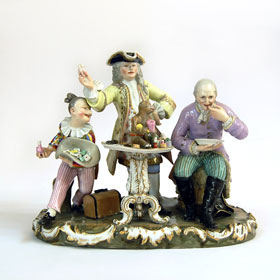 1937 the State Museum of Armenia received ancient Greek metal statuettes of gods and heros together with black-figure and red-figure earthen amphorae, craters, lekythosi, and other vessels of the seventh century B.C.-first centuries A.D. from the Hermitage. The earthenware is decorated with scenes from mythology and everyday life. Among the objects also presented by the Hermitage to the National Gallery of Armenia were Russian, European and Oriental china statuettes, candlesticks, and glass cups. Most noteworthy is the production of the St. Petersburg imperial Porcelain Works, as well as of the private factories of Gardner, Popov, Miklashevsky, and others. European porcelain is represented by the production of the Meissen, Berlin, Sevres and Vienna factories. In the small collection of furniture, noteworthy are the unique French engraved church credence of the early sixteenth century, the Italian wedding chest (cassone) of the sixteenth century, and the Dutch chair of the seventeenth century.
The oriental collection of porcelain includes valuable and elegant underglaze blue (kobalt) Chinese vases, plates, dishes and tea-cups of the seventeenth-nineteenth centuries.These belong to the ''famille verte'' and ''famille rose'', and are decorated with flowers, birds, fruits, insects, multi-figure scenes from everyday life and myths. Some porcelain articles which were transferred in 1931 from the Etchmiadzin Museum to the Gallery belong to sets bearing Armenian inscriptions, ligatures and emblems of clergymen. These were manufactured in China in the eighteenth-nineteenth centuries by order of the Armenian Church. They stand witness to the centuries long-trade connections between Armenia and China, and although their artistic quality is inferior to the porcelain made for the Chinese market, these items are still of historical.
The eastern collection also includes interesting specimens of Iranian painted ceramic crockery, slabs, textiles, and the metalwork of the sixteenth-nineteenth centuries Japanese porcelain and bone-made netsukes.
In 1976 the collection of Garen Soghomonyan from Yerevan, consisting of 500 works, entered the Museum, enlarging the collections of Russian and European Furniture, mirrors, porcelain and clocks. Among the donors deserving a special mention are Vardan Barakian (Romania) and Vahan Vahanian (Tbilisi) who presented their large and multifarious collections to the National Gallery of Armenia thus enriching the collection of European applied art.
Satenik Pezikian who had repatriated from Turkey in 1958 gave the Gallery seventy-three units of embroidery belonging to the school of Urha, the most original school among several large centers of Armenian embroidery. Later the Museum purchased from S. Pezikian about 200 carbon paper copies of fragments or ornaments embroidered on towels, shawls, and clothes made in Urhay in 1914-15, which were exported to Europe and America and miraculously saved from the horrors of World War 1.
In 1968, when the Department of decorative applied art was established and its collections were revised, it becomes obvious that the Armenian collection needed purposeful enlargement. Objects were collected from Yerevan and other regions of Armenia. Among other acquisitions in 1976 the Gallery purchased the collection of producer Gevorg Alagiozyan, a well-known collector from Yerevan. Consisting of Armenian carpets, pottery, silverwork, and engraved wood of the eighteenth-nineteenth centuries, this collection is very important for the study of Armenian decorative art. 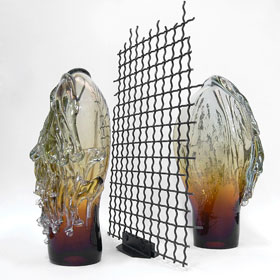
In order to guarantee the fullness of the modem section of the collection, the Museum has periodically obtained at its choice works of many artists and bought by the Ministry of Culture. These works came from general and personal exhibitions held at various times and preserved in special collections. For this reason the Museum possesses works by the eminent potters Hripsime Simonian (1916-1998), Ruben Shahverdian (1900-1977), Derenik Danielyan (1912-1994), Hmayak Bdeyan (1925), Norayr Aghajanyan (1927), Van Soghomonian (1937), Nona Gabrielyan (1944), silversmiths Zhirayr Chuloyan (1918-1992), Vahan Hatsagortsyan (1880-1967), glass-blowers, Azat Leiloyan (1926), Henrik Nikolyan (1936), Sergey Gasparyan (1937), and others.
In 1990 the museum acquired more than fifty clay figure sculpture groups and decorative trays by Ruben Shahverdyan (1900-1977), a potter of remarkably original style and prominent individuality. The typical features of his works are modern interpretation of folk traditions and high artistic quality
A big collection of about 750 articles of crystal ware entered the Gallery in 2002. It consists of specimens of the Arzni Crystal Works famous in the Soviet period, as well as original works by distinguished artists. Undoubtedly, this collection significantly contributes to the study of the history of glasswork in the second half of the twentieth century.
Trough the permanent exposition and special thematic exhibitions, visitors of the National Gallery have the opportunity to become familiar with various spheres of decorative-applied art. Thanks to its close relationship with everyday life, this type of art has always been the most understandable and popular.
Permanent
exhibition
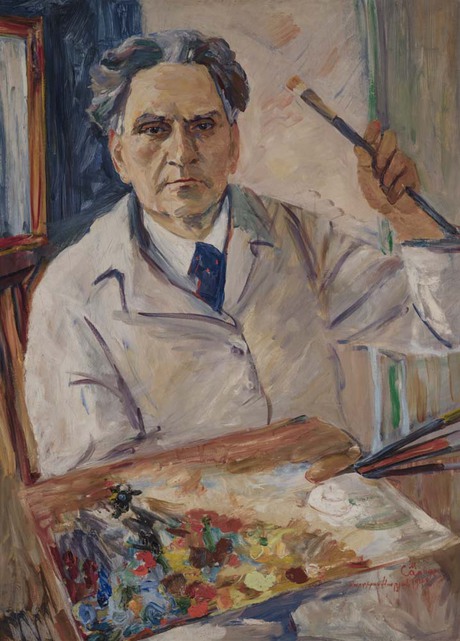
Sarian Martiros
Self-portrait (1942)
canvas, oil
100x73 cm
